Delhi is one of India’s most competitive business markets. Whether you run a local service company, B2B business, ecommerce store, clinic, manufacturer, real estate company or professional consultancy, your potential customers are already searching online before making a decision.
The challenge is no longer simply having a website.
Your business needs to appear when the right customer searches for the products, services or solutions you provide.
That is where SEO in Delhi becomes important.
A well-planned SEO strategy can help a business improve its visibility on Google, attract relevant organic traffic, generate qualified enquiries and reduce its dependence on paid advertising over time.
But SEO in 2026 is also different from what it was a few years ago.
Businesses now need to think beyond traditional blue-link rankings. Google AI Overviews, AI Mode, conversational search and AI-powered discovery are changing how people research businesses and make decisions.
The good news is that the fundamentals have not disappeared. Google continues to state that established SEO best practices remain relevant for its generative AI search experiences as well.
Let’s understand how businesses in Delhi can build an SEO strategy that generates real visibility and leads.
Why SEO Matters for Businesses in Delhi
Delhi has businesses competing in almost every possible industry.
Search for terms such as:
“interior designer in Delhi”
“corporate lawyer Delhi”
“SEO consultant in Delhi”
“dentist near me”
“industrial supplier Delhi”
“digital marketing company Delhi”
“restaurant in Connaught Place”
and you will usually find multiple businesses competing for the same customer.
Being present somewhere on Google is therefore not enough.
Your objective should be to appear for searches that have genuine commercial relevance to your business.
For example, attracting 10,000 visitors searching for unrelated informational topics may be less valuable than attracting 300 people actively looking for the service you provide.
Good SEO focuses on search intent, relevance and business outcomes, not traffic numbers alone.
Google’s own Search guidance recommends using words that people actually use to find your content while creating helpful, reliable and people-first pages rather than content created only to manipulate rankings.
What Is SEO in Delhi?
SEO in Delhi refers to optimizing a website and its wider online presence so that it becomes more visible when people search for relevant businesses, SEO services or information in Delhi and nearby markets.
A complete SEO strategy normally includes:
Technical SEO, which helps search engines properly crawl, render, understand and index the website.
Keyword research, which identifies what potential customers actually search.
On-page SEO, which improves individual pages around search intent and relevance.
Content strategy, which builds authority around topics connected to the business.
Local SEO, which improves visibility for location-based searches and Google Maps.
Authority building, which strengthens trust through credible mentions, links and reputation signals.
Conversion optimization, which helps organic visitors become enquiries or customers.
And increasingly, AI search optimization, which helps content remain understandable, useful and discoverable across generative search experiences.
SEO therefore isn’t one activity. It is a combination of technical, content, authority and user-experience improvements working together.
Start With Search Intent, Not Just Keywords
One of the most common SEO mistakes is choosing keywords only because they have search volume.
A better strategy starts by understanding why someone is searching.
Consider these searches:
“what is SEO”
“SEO pricing Delhi”
“SEO consultant in Delhi”
“best SEO expert in Delhi”
“SEO audit service Delhi”
All five relate to SEO, but the person behind each search is at a different stage.
Someone searching “what is SEO” is probably learning.
Someone searching “SEO consultant in Delhi” may already be comparing providers.
Someone searching “SEO audit service Delhi” may have an immediate problem they want solved.
Your website needs pages that match these different types of intent rather than forcing every keyword onto the homepage.
This is why an effective SEO website architecture may include service pages, location pages, industry pages, case studies and informational articles working together.
Build Dedicated Service and Location Pages

If your company serves Delhi, your website should make that relationship clear.
Suppose you provide accounting services.
Instead of trying to rank one homepage for every variation, you might have relevant pages around specific services and markets.
For example:
Chartered Accountant Services
GST Consulting
Business Registration
Tax Consulting
and a genuinely useful Delhi-focused page when location intent matters.
The same principle applies to SEO businesses, healthcare, interior design, legal services, home services, manufacturing and many other industries.
However, avoid creating dozens of nearly identical pages only by replacing city names.
A page targeting Delhi should actually help a Delhi-based customer.
It can include relevant service information, areas served, common customer requirements, local examples, FAQs, proof of work and clear contact information.
Unique value matters much more than simply adding “Delhi” repeatedly.
Technical SEO Is the Foundation
Strong content cannot reach its full potential if search engines struggle to access or understand the website.
A technical SEO audit should evaluate areas such as:
crawlability and indexability, XML sitemaps, robots directives, canonical tags, URL structure, internal linking, mobile usability, page performance, duplicate pages, JavaScript rendering, structured data and HTTP status codes.
One important question is:
Can Google reliably discover, crawl, understand and index the pages you actually want customers to find?
For example, a business may have an excellent service page but accidentally apply a noindex directive.
Another website may have five different URLs showing essentially the same content.
Another may bury important services several clicks deep in the website.
Technical SEO helps remove these barriers.
It does not guarantee rankings by itself, but it gives your content a stronger foundation.
Keyword Research for Delhi Businesses
Keyword research should combine search demand with commercial relevance.
A Delhi business should typically examine several types of keywords.
Service Keywords
These describe what you sell.
Examples include:
“SEO services”
“office interior design”
“corporate catering”
“industrial water treatment”
Location Keywords
These combine the service with geographic intent.
Examples:
“SEO services in Delhi”
“SEO consultant in Delhi”
“interior designer in South Delhi”
“corporate caterer Delhi NCR”
Problem-Based Keywords
These describe problems rather than services.
For example:
“website traffic suddenly dropped”
“Google Business Profile not ranking”
“how to increase local enquiries”
“website not appearing on Google”
Comparison and Decision Keywords
People close to making a decision often search phrases such as:
“best SEO consultant in Delhi”
“SEO agency vs SEO freelancer”
“SEO cost in Delhi”
“how to choose an SEO expert”
These searches can be commercially valuable because the user is often evaluating options.
The objective is not to place every keyword everywhere.
Instead, map each meaningful search intent to the most relevant page.
Local SEO Can Be Critical for Delhi Businesses
For businesses serving customers within a particular location, local SEO can become one of the highest-value acquisition channels.
A strong local strategy begins with accurate and complete business information.
Your Google Business Profile should clearly represent your business name, category, services, operating hours, contact information and other relevant details.
Customer reviews also matter because they help potential customers evaluate trust before contacting a business.
Google explains that its local results are mainly influenced by relevance, distance and prominence. Complete business information can help Google understand relevance, while links, reviews and wider recognition can contribute to prominence.
This means local SEO is not simply about inserting “Delhi” into a webpage.
You need to build a strong and consistent local presence.
Optimize Your Google Business Profile
For eligible local businesses, Google Business Profile should work alongside the website rather than separately from it.
Keep important information accurate and consistent.
Use the most relevant business category.
Add genuine business photos.
Keep opening hours updated.
Describe services clearly.
Respond professionally to customer reviews.
Link users to the most useful page on your website.
If you operate across Delhi NCR, do not try to manipulate local visibility by creating fake offices or fake business locations.
Build genuine location relevance instead.
Create Content Around Real Customer Questions

Businesses often think blogging means publishing generic articles every week.
That usually produces a large website without necessarily producing meaningful SEO results.
A better content strategy begins with actual customer questions.
A B2B manufacturer might publish content explaining specifications, applications, installation considerations, maintenance requirements and comparisons.
A legal consultant may answer frequently asked questions related to business compliance.
A software company may explain integrations, workflows, common implementation problems and use cases.
An SEO consultant may cover technical SEO problems, ranking changes, local SEO, AI search, content strategies and real experiments.
This creates what matters far more than simply producing “blogs”: topical depth and useful expertise.
Google also recommends creating helpful, reliable, people-first content that provides original value and is primarily created for users rather than search engines.
Build Topical Authority Instead of Publishing Random Blogs
Imagine a Delhi-based business wants to become known for a particular service.
Publishing one page about that service may not establish much depth.
A stronger content ecosystem can cover the main service, related problems, FAQs, comparisons, case studies and supporting educational topics.
For example, an SEO website might build a cluster around:
Technical SEO
Local SEO
Google Search Console
Content Strategy
SEO Audits
Google Algorithm Updates
AI Search
AEO
GEO
Structured Data
SEO Case Studies
These pages should be connected through logical internal links.
Over time, the website becomes easier for users and search engines to understand.
Internal Linking Is Often Underrated
Internal links help search engines discover pages and understand relationships between topics.
They also help visitors move naturally through the website.
For example, this article about SEO in Delhi can link to a dedicated SEO Expert in Delhi service page.
A section discussing technical problems can link to a Technical SEO Consultant page.
The AI search section can link to an AI SEO, AEO or GEO service page.
Case studies can link back to relevant services.
The objective is to build a connected information architecture rather than isolated pages.
Use On-Page SEO Naturally
On-page SEO remains important, but it should not make content robotic.
The main keyword should appear naturally in important places such as:
the page title, H1, introduction, relevant subheadings, body copy, image context and internal links where appropriate.
That does not mean repeating “SEO in Delhi” every few sentences.
Search engines are much better at understanding topics and related language than older SEO approaches assumed.
Write primarily for the person reading the page.
Then make sure the page’s purpose is unambiguous.
Build Trust and Demonstrate Real Experience
In competitive markets, ranking is only part of the challenge.
The visitor also has to trust you enough to make an enquiry.
A strong website should clearly show who is behind the business.
Depending on the industry, useful trust signals may include:
real team or author information, case studies, genuine testimonials, client work, professional experience, contact details, transparent service information and external references.
Avoid publishing fake numbers, fake testimonials or unsupported “No.1” claims.
If you have a strong result, show the context behind it.
Instead of simply writing:
“300% traffic increase”
a proper case study might explain the starting situation, problems identified, work completed, timeline and measurable outcome.
That creates far more credibility.
Backlinks Still Matter, but Quality Matters More
Links from other websites can help search engines discover your brand and understand its wider reputation.
But not every backlink has equal value.
A mention from a respected publication, industry website, professional association, genuine business partner or relevant resource can carry far more credibility than hundreds of low-quality profile links.
Avoid building backlinks simply because they are easy to obtain.
Good authority building often comes from doing something worth mentioning:
publishing original research, contributing expert commentary, creating useful tools, producing unique industry data, publishing strong case studies or developing genuine partnerships.
SEO Should Be Connected to Lead Generation
SEO traffic is valuable only when it supports the business.
Every commercially important page should make the next step obvious.
Possible conversion actions include:
requesting a consultation, booking a call, requesting a quotation, sending a WhatsApp message, submitting an enquiry or requesting an audit.
The CTA should match the visitor’s stage.
Someone reading an educational guide may not be ready to purchase immediately.
Offering a useful audit, consultation or related resource can create a lower-friction next step.
Also measure more than traffic.
Track actions such as:
form submissions, phone calls, WhatsApp clicks, booked appointments, qualified enquiries and eventual revenue where possible.
The goal is not simply more organic traffic.
The goal is more useful organic traffic.
What About AI Overviews, AI Mode and AI Search?

Search behavior is expanding beyond traditional result pages.
Users can now encounter businesses and information through Google AI Overviews, Google AI Mode and other AI-powered discovery experiences.
This has created new terminology such as AEO — Answer Engine Optimization and GEO — Generative Engine Optimization.
However, businesses should avoid treating AI optimization as a collection of shortcuts.
Google’s 2026 guidance states that established SEO practices remain the foundation for visibility in its generative AI search experiences. It particularly emphasizes valuable, unique, expert-led content, technical accessibility and good user experience rather than chasing supposed “AEO/GEO hacks.”
For businesses, that means focusing on:
clear entity information,
strong technical SEO,
original expertise,
well-structured content,
accurate information,
credible external references,
useful images and video,
and content that directly answers genuine customer needs.
In other words, AI search increases the importance of building a genuinely useful and credible web presence.
Don’t Forget Your Brand Entity
Businesses often optimize only product and service keywords but ignore their own brand identity.
Search engines and AI systems should be able to clearly understand:
who you are,
what your business does,
where you operate,
who works there,
what topics you are associated with,
and where authoritative information about you can be found.
Keep your business name, professional information and important facts consistent across your website and legitimate external profiles.
For professionals and consultants, a detailed About page, accurate author profile and consistent professional presence can become especially valuable.
Clear authorship also aligns with Google’s people-first guidance, which encourages publishers to make it obvious who created content and provide background about the author.
Common SEO Mistakes Delhi Businesses Should Avoid
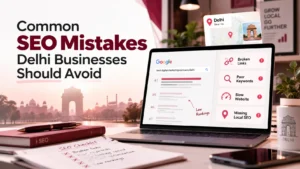
Targeting Only High-Volume Keywords
High search volume does not automatically mean high business value.
Commercial relevance should come first.
Creating Too Many Similar Location Pages
Do not create hundreds of pages with almost identical text for different locations.
Each useful location page should serve a genuine user need.
Buying Low-Quality Backlinks
Large quantities of irrelevant links rarely create a sustainable competitive advantage.
Ignoring Technical Problems
Great content cannot compensate for serious crawling, indexing or website architecture problems.
Publishing Generic AI Content at Scale
AI can assist research and production, but simply generating hundreds of generic articles adds little value.
Google continues to emphasize unique, useful, people-first content rather than mass-produced commodity information.
Obsessing Over Rankings Alone
A keyword ranking #1 is not particularly useful if it produces no enquiries.
Measure organic business impact.
Ignoring Conversion Experience
Slow pages, unclear CTAs, complicated forms and weak trust signals can waste the traffic SEO generates.
How Long Does SEO Take in Delhi?
There is no universal SEO timeline.
Results depend on several factors, including:
your current website condition,
competition,
existing authority,
industry,
target keywords,
technical problems,
content quality,
and the amount of work required.
A well-established website fixing a specific technical issue can sometimes see improvements relatively quickly.
A new website entering a highly competitive Delhi market may require considerably more time to build authority and visibility.
Be cautious of anyone guaranteeing a specific #1 Google ranking within a fixed number of days.
SEO involves competition, algorithms and many factors outside any consultant’s direct control.
A better expectation is continuous improvement in visibility, relevant rankings, qualified organic traffic and conversions.
How to Choose the Best SEO Consultant in Delhi
Businesses frequently search for the best SEO consultant in Delhi, but “best” should depend on the requirements of your business.
Before hiring an SEO consultant, ask how they evaluate search intent, technical SEO, competitors, content opportunities, backlinks and conversions.
Ask what they will measure.
Ask whether you will receive clear reporting.
Ask how the strategy connects with actual business goals.
And most importantly, check whether their recommendations make sense for your website rather than following the same checklist for every client.
The right SEO consultant should be able to explain not only what needs to change, but why it matters.
Can a Delhi Business Rank Across India?
Yes.
Being based in Delhi does not mean your website can only target Delhi.
The correct strategy depends on your business model.
A restaurant may primarily need local visibility.
A B2B manufacturer based in Delhi may serve customers across India.
A software company may target national or even international markets.
A consultant may work with clients remotely across multiple locations.
Your website architecture and keyword strategy should reflect the actual geographic market you serve.
Delhi-focused pages can target local intent while broader service pages and content can build national visibility.
Is Local SEO Different From Normal SEO?
Local SEO and broader organic SEO overlap, but their emphasis differs.
Traditional organic SEO may target searches regardless of a user’s exact location.
Local SEO focuses more heavily on searches where proximity and geographic relevance influence the results.
For example:
“what is technical SEO”
is mainly informational.
“SEO consultant in Delhi”
has clear location intent.
“SEO consultant near me”
is even more dependent on the searcher’s location.
A business serving a local market often needs both traditional SEO and local SEO working together.
Should Businesses Still Invest in SEO in 2026?
Yes, but the strategy needs to evolve.
SEO is no longer just about inserting keywords into pages and building links.
Modern SEO combines:
technical accessibility,
search intent,
useful content,
brand authority,
user experience,
structured information,
local visibility,
conversion optimization,
and increasingly AI-powered search discovery.
Businesses that invest in genuine expertise and helpful content have an opportunity to build visibility across multiple search experiences rather than relying on a single advertising channel.
Final Thoughts: SEO in Delhi Should Be Built Around Business Growth
Delhi is competitive, and that competition is unlikely to decrease.
Simply publishing a website and waiting for customers to find it is not a strategy.
Businesses need to understand what their customers search, create pages that genuinely satisfy those searches, maintain a technically strong website, build trust and make it easy for visitors to take the next step.
The strongest SEO strategies combine visibility with relevance and conversion.
Rankings matter.
Traffic matters.
But ultimately, the most useful question is:
Is organic search helping the business generate better opportunities?
If the answer is no, the SEO strategy needs to change.
Need Help Improving Your SEO?
If your website is not generating enough visibility, qualified traffic or enquiries from Google, start by identifying where the real gaps are.
A professional SEO audit can uncover technical issues, keyword opportunities, content gaps, competitor advantages and conversion problems that may be limiting growth.
Deepak Awasthi is an SEO and organic growth professional based in Delhi, India, specializing in Technical SEO, Content Strategy, Local SEO, AEO, GEO and AI Search Optimization.
Frequently Asked Questions
Why is local SEO important for Delhi businesses?
Local SEO helps eligible businesses become more visible when potential customers perform location-based searches. Google says local results are mainly determined using relevance, distance and prominence.
How much does SEO cost in Delhi?
SEO pricing depends on the size of the website, industry competition, target market, technical condition and scope of work. A local business website may require a very different strategy from a national ecommerce or enterprise website.
Who is the best SEO expert in Delhi?
There is no single SEO professional who is automatically the best fit for every business. Compare consultants based on relevant expertise, technical knowledge, strategy, transparency, genuine results and their ability to connect SEO work with business outcomes.
What should an SEO consultant in Delhi do?
An SEO consultant should evaluate the website's technical health, search visibility, competitors, keyword opportunities, content, authority signals and conversion journey before creating a prioritized strategy for organic growth.
How long does SEO take to show results?
SEO timelines vary according to competition, website history, technical condition, authority and target keywords. Some improvements may appear relatively quickly, while competitive organic growth normally requires sustained work.
Can SEO generate leads for local businesses?
Yes. When a website targets commercially relevant searches and provides a strong conversion path, SEO can generate qualified enquiries from people already looking for the business's services.
Does SEO help with Google AI Overviews and AI Mode?
Yes. Google's current guidance says traditional SEO best practices remain relevant for its generative AI search experiences. Strong technical accessibility, useful original content and a trustworthy web presence continue to form the foundation for visibility.
Do I need separate pages for every Delhi location?
Not necessarily. Location pages should only be created when they provide genuine unique value to users. Creating large numbers of nearly identical city or neighbourhood pages primarily for rankings is not a good long-term strategy.
Is SEO better than Google Ads?
SEO and paid advertising serve different purposes. Ads can generate visibility quickly while campaigns are active, whereas SEO can build organic visibility and demand capture over time. Many businesses benefit from using both strategically rather than treating them as direct replacements.